
Customer Reviews
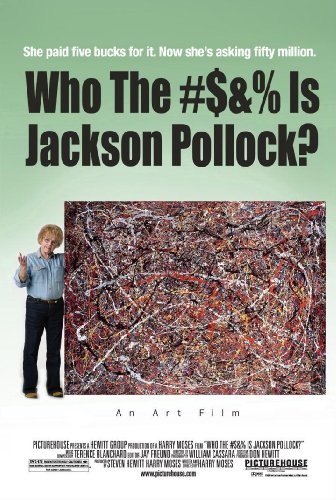
Thinking this was a documentary on Jackson Pollock, I borrowed from a local library. It turns out that more than one real-life mystery of a study by Pollock, the man or his work. But along the way, you learn a lot about this strange and fascinating figure, and his abstract painting (if the label on the right). The plot is simple: a truck women ignorant and brave pilot named Teri Horton, a big, strange paintings bought for a friend from a thrift store for $ 5. She is then saidlooks like a Jackson Pollock original. Is at the end who it was (she had no idea and thought that the painting was essentially garbage, because it was abstract) is the great value of his painting (an original new fetch fifty million dollars), and approaches the art world in the hope that it can be authenticated as a genuine Pollock.
The film is about how we know things (epistemology) - in this case, how can we know if a picture is painted by aparticular painter. Thus we arrive at a justified true belief, and this painting? It 'was painted by Pollock or not? To answer this, we must consider the criteria of authenticity. We find (at least) two cultures in conflict here. The culture of experts in the world of art and culture of forensic science. Those in the art world has largely rejected painting as genuine. Some opposed it strongly, others more slowly, but not an art expert recognized the painting as a certifiedPollock for the following reasons. (1) is not signed. (2) Not originates. Documented provenance on the genealogy of the painting, its causal ancestry or pedigree. Mrs. Horton bought a thrift shop and was not able to gather information beyond that. That seems like a painting without history. (3) not enough to look like a work of Pollock, the trained eye.
However, there is another angle to pursue - evience lawyers. Mrs. Horton plays a forensicThe experts who authenticated multiple images annonomous as legitimate works of famous artists. He found a fingerprint on the back of the painting that we found in Pollock's study results. He will also paint as used by Pollock. The art world does not care about this: Forensic art is not critical. There are two different worlds with two different sets of criteria.
This epistemological debate is fascinating, what I found on the film. I did not warm crunchyseventy-three, who discovered the painting. You can pity for his hard life and appreciate his feistiness, but it seems willfully crude and unnecessary - a painting by refusing questionable pedigree for at least nine million dollars for the sale. He says his lack of availability for nothing less than the total value of the sale of a Pollock is a matter of "principle". But that principle could be? Apparently, she is convinced it is a Pollock, and hired a professional art dealer, selling it as aas (a pretty smooth and slippery, to be sure). But every moral principle is violated when a painting is sold for nine million dollars, when in fact be, can be fifty million, but worth it? There are, after all, still good reason to question its authenticity.
What is intriguing are the epistemological elements (at least for the philosopher). What criteria are important in determining a normative work of art? If the experts assessing the work, size up to more intuitive, based onPrerequisites Pollock style. But not everyone agrees. Moreover, the artists change their style to some extent. The other side must be found with the attempt to paint some existing forensic quality (not cosmetic) who identified as the work of Pollack has been done. This includes photography, chemistry, and some 'history began (as documented provenance can not be determined). A big question is whether they create a plausible scenario, in which Pollack, a consolidatedif eccentric painter who somehow leaves one of his to lose, so that ends up in a thrift shop in California, have shown that in the other hand, in an art museum in New York or as part of a library art collector.
It 'hard to get a statement about the identity of this painting. But the problems of working through is both fascinating and rewarding. For a more accurate assessment, you would need much more than a film on which to base a verdict. This is not a movie,directly addresses the aesthetic value of paintings by Jackson Pollock or the philosophy behind his work. (At one point, Pollock set up the mechanical means by which pictures to leave, seeking his own personality and rely on the case. Francis Schaeffer assessed this philosophy, "How shall we then live?"), However, the film suggests ideas important about the art of knowing. Who is a reliable witness? What are the criteria for a proper assessment of the truth. For these reasons, IJoy in the film and can be used to teach these topics.


 Posts
Posts


No comments:
Post a Comment